
Footwork First: The Quiet Skill That Wins Club Badminton
Watch the strongest player at your club for a few rallies and something odd happens: they never seem to be in a hurry. The shuttle drops into a corner and they are already there, upright and balanced, playing the shot with time to spare. It looks like reading the game, and partly it is. Mostly, though, it is their feet. Good badminton footwork is the quiet skill that decides most club matches, and it is the one thing almost every improving player under trains.
Why your feet matter more than your swing
Badminton is a game of angles and recovery. A rally is really a series of tiny sprints, one to each corner, with a fraction of a second to plant, hit and get back. If you arrive late or off balance, you are forced into a defensive reply no matter how clean your technique is. Arrive early and set, and suddenly the whole court opens up: you can hold your shot, disguise it, or attack a length that a scrambling opponent simply cannot reach.
This is why coaches say you play badminton with your legs and finish with your arm. The swing is the easy part to practise because it feels satisfying. Movement is harder to fall in love with, which is exactly why improving it gives you such an edge. You do not need to be quick to move well. You need to be efficient.
Everything starts from base
Base is your home position, roughly in the middle of the court, and every rally in singles returns to it. Standing at base you want a low, ready stance: feet a little wider than your shoulders, knees soft, weight forward on the balls of your feet and your racket up in front of you. You should feel spring loaded, like you are about to push off in any direction rather than standing and waiting.
From base, the single most valuable habit in the whole sport is the split step. As your opponent is about to strike the shuttle, you make a small, light hop that lands you on both feet, knees bent, an instant before they hit. The landing loads your legs like a coiled spring and lets you push explosively towards wherever the shuttle is going. Time it so you land just as they make contact, and you will move a full beat sooner than an opponent who is flat footed. Miss the timing and you are back to guessing.
The six corners
Once you can split step and push, movement becomes a matter of covering six points on the court: the two front corners at the net, the two mid court sides, and the two rear corners. Almost every shuttle you chase lives at one of these six spots, so club training the world over is built around moving cleanly to each and recovering to base.
To the front
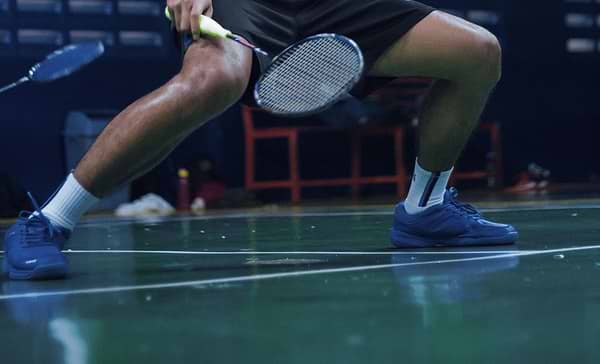
For the net corners, lead with your racket leg and finish on a lunge, that long final stride that lets you reach low without falling forward. Keep your head up and your chest tall as you lunge; if your nose drops below your knee you have overreached, and recovery will be slow. A strong lunge is half about getting there and half about being able to push straight back out of it.
To the sides and the back
For the mid court and rear corners, the chassé is your friend. A chassé is a quick shuffle where one foot chases the other without crossing over, letting you cover ground smoothly while staying square and balanced. Travelling to the rear forehand corner, most players chassé back and turn side on, jumping into the shot if there is time and landing ready to move forward again. The aim is always the same: arrive set, hit, and get out.
Recover, do not admire
The most common club error is watching your own shot. You play a lovely clear, admire its flight, and only then start moving back to base, by which point the reply is already past you. Trained players do the opposite: the moment the shuttle leaves their racket they are pushing back towards base, eyes up, ready to split step again. Treat every shot as unfinished until you have recovered. Rallies are won by the player who is ready for the next ball, not the one who played the prettiest last one.
Simple ways to build it
The good news is that footwork improves fast because so few people train it. You do not even need a partner or a shuttle.
- Shadow footwork. Stand at base and move to each of the six corners in turn, playing an imaginary shot and recovering to the middle each time. Two or three minutes of this as a warm up, focusing on a clean split step and a balanced arrival, is worth more than it looks.
- Split step on a call. Have a partner point to a corner, or call it out, just as you split step, then move and recover. This trains the reaction and the timing together, which is how they are used in a real rally.
- Ghosting under fatigue. Once the pattern is grooved, add pace and do short, sharp sets. Tired footwork is where bad habits creep in, so practising good movement when your legs are heavy pays off in the third game of a match.
Film yourself for a minute if you can. Almost everyone is surprised by how much they cross their feet, stand tall between shots, or forget to recover. You cannot fix what you cannot see.
The one piece of kit that actually helps
Footwork is a skill, not a purchase, so no product will do the work for you. That said, one thing genuinely matters: what is on your feet. Badminton involves constant stopping, lunging and pushing off across a smooth indoor surface, and running trainers are built for rolling forward, not for that sideways grip and sudden braking. They also lack the lateral support that a hard lunge demands, which is a quick route to a rolled ankle. A well fitted pair of court shoes with a gum sole and low, stable profile lets you plant and change direction with confidence, so you can actually trust the technique you are building. If you are unsure what to look for, our badminton shoes buying guide walks through fit, cushioning and grip in plain terms.
Where to start this week
Pick one thing. For most club players the highest return is the split step, simply because so few people do it consistently. Spend a fortnight landing that little hop just as your opponent strikes, push out of it, and make yourself recover to base after every shot. It will feel awkward for a session or two, then it will feel like the shuttle has slowed down. That is not the shuttle. That is your feet, finally giving your racket the time it always needed.


