
How to Hold a Badminton Racket: The Grips That Quietly Change Your Game
Ask ten club players what has made the biggest difference to their game and you will hear about smashes, footwork, maybe a new racket. Almost nobody says "the way I hold the handle". Yet the grip is the one thing your hand does on every shot, and getting it right unlocks touch, power and deception that arm strength alone cannot fake. If you have ever wondered how to hold a badminton racket properly, this piece will save you months of quietly building bad habits.
Why the grip matters more than you think
Badminton is a wrist and finger sport far more than an arm sport. The shuttle is light, the rallies are fast, and the difference between a flat clear and a cutting drop can be a few degrees of racket-face angle. That angle comes from your fingers. Hold the handle like a hammer and you lock your wrist, kill your reach and telegraph every shot. Hold it correctly and the racket becomes an extension of your hand, able to change direction at the last possible moment.
The good news is that there is nothing mysterious here. There are really only two grips you need to master, plus a couple of variations worth knowing, and learning them puts you ahead of most players you meet on a Tuesday-night court.
The forehand grip: start with a handshake
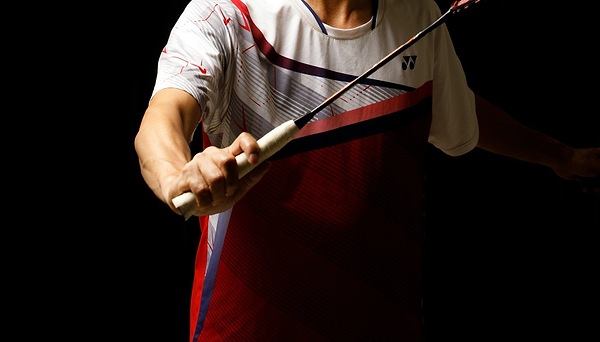
The forehand grip, sometimes called the basic grip, is the one you will use for the majority of shots on your racket side. Finding it is simple: hold the racket by the shaft with your non-playing hand so the strings are perpendicular to the floor, then "shake hands" with the handle. Your thumb and index finger should form a soft V down the top of the grip, and there should be a small gap between your index and middle fingers, a little like holding a pen rather than gripping a suitcase.
The key is that the fingers are spread and relaxed, not bunched at the bottom of the handle. That spread gives you control, and the space in your palm lets the handle rotate slightly when you play different shots. This is the grip for clears, drives, net shots and, with a snap of the forearm, the smash.
The backhand grip: bring the thumb up
The backhand grip is where most improving players find real, fast gains. From the forehand grip, rotate the racket slightly so your thumb comes to rest flat along the wider back bevel of the handle. That thumb is your power source: it presses against the handle to drive the racket through the shuttle, which is why strong backhand clears feel like a "push" from the thumb rather than a swing from the arm.
Plenty of beginners avoid their backhand entirely and run around every shot to play a forehand instead. It works for a while, but good opponents will simply keep attacking the space you leave. Committing ten minutes to the thumb-up backhand grip is one of the highest-value things a club player can practise.
When and how to switch between grips
Here is the part that separates comfortable players from stiff ones: in a real rally you are constantly, almost invisibly, switching between the two grips. There is no time to rearrange your fingers when a drive comes back at your body in a doubles exchange, so the change has to become automatic.
The switch itself is small. You are not re-gripping from scratch, just letting the handle rotate a few degrees in relaxed fingers, often nudged by your thumb and index finger. This only works if your grip is loose between shots, which brings us to the single most common fault of all.
A note on the panhandle grip
The "panhandle" or "frying-pan" grip, where you turn the racket face flat and hold it as if flipping an egg, feels natural to beginners because it makes hitting a shuttle right in front of your face easy. Use it sparingly. It is useful for a few specific net kills, but as a default it flattens the racket face, robs you of reach and makes proper overhead shots almost impossible. Treat it as a special-occasion grip, not your everyday one.
How tightly should you hold the racket?
Loosely. Far more loosely than instinct suggests. For most of a rally your grip should be light enough that someone could almost pluck the racket from your hand. You only squeeze at the moment of contact, tightening the fingers to add speed and control, then relaxing again the instant the shuttle leaves the strings.
This "relax, squeeze, relax" rhythm does two big jobs. It generates racket-head speed (a whip is faster than a rigid stick), and it lets the handle turn freely so you can switch grips. A permanently clenched fist is slower, more tiring and a fast track to a sore forearm, so if your hand aches after an hour of play, your grip pressure is almost certainly the culprit.
Grip size, sweat and comfort
Technique comes first, but the physical grip on your racket matters too. A handle that is too thick stops your fingers spreading and slows the switch between forehand and backhand; too thin and you may squeeze harder to feel secure, undoing all the relaxation you have just learned. Many players build the handle up with an overgrip until it sits comfortably in a relaxed hand.
Overgrips are the cheap upgrade that punches above its weight. A fresh, tacky overgrip keeps the racket from slipping when your hands sweat, and a towelling grip soaks up moisture if you play hard or in warm halls. As a rough guide, change or replace your overgrip once it stops feeling tacky or starts to slide, which for a regular player might be every few weeks. If you want the full run-down on replacement grips, overgrips and towel grips, our grips buying guide walks through the differences, and you can browse our range of grips and overgrips when yours is due a change. Grip thickness also links to how a racket feels overall, so it is worth keeping in mind when choosing a racket too.
Making a good grip second nature
None of this helps if you only think about it in the changing room. The trick is to build the grips into gentle, repeatable practice so your hand stops needing your brain's permission.
Two simple drills do most of the work. First, shadow the switch: stand still and rotate the racket between the forehand and backhand grips over and over while watching your fingers, until it feels boring. Second, play a relaxed knock-up but consciously loosen your grip between every shot, only squeezing at contact. Do these for a few minutes each session and within a month the correct grip will feel like the natural one, and the old hammer-fist will feel as strange as it always should have.
Grip is not glamorous, and it will never trend the way a new racket launch does. But it is the quiet fundamental that makes everything else, the footwork, the deception, the smash you are so proud of, actually work. Sort out how you hold the racket, and the rest of your game finally has something solid to stand on.


