
How to Play Singles Badminton: The Tactics That Win Long Rallies
Singles badminton looks simple from the sideline. One player each side, a big empty court, a shuttle going back and forth. Step on to play it, though, and you quickly learn it is one of the most demanding games in sport. There is nobody to cover for you, no half of the court to hide in, and no hiding your legs when the rally reaches its thirtieth stroke. Learning how to play badminton singles well is really about learning to control space, control the shuttle, and outlast the person on the other side of the net.
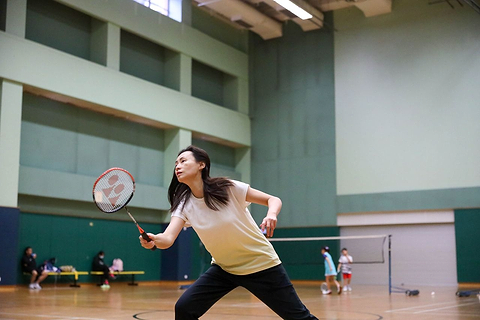
Is badminton singles or doubles harder?
It is the question every club player argues about, and the honest answer is that they are hard in different ways. Doubles is faster, flatter and more about sharp reflexes and slick partner rotation. Singles is slower to build but far more physical: you alone are responsible for the whole length and width of the court, so it rewards patience, footwork and stamina more than raw power. Many players find singles the tougher workout, because the rallies are longer and there is no one to share the running with. If you are coming from the doubles court, the biggest adjustment is learning to wait, since the point is usually won three or four shots after the opening you created, not on the first big hit.
None of this needs expensive kit to enjoy, but a couple of things do make the game easier on your body. Because you cover so much ground, a pair of proper indoor court shoes with good grip and lateral support will save your ankles over a long match, far more than running trainers ever will. And a racket that suits your style helps you generate the deep, floating clears singles is built on, so it is worth taking a moment to find the right racket for you rather than borrowing whatever is in the bag.
How big is a singles badminton court?
The court is the same rectangle for both formats, but the lines you use change. In singles the court is long and narrow: the two side tramlines (the doubles alleys) are out, so the playing width shrinks to 5.18 metres, while the full length back to the baseline, 13.4 metres, stays in. That single change reshapes the whole game. Because the sides are tighter, straight rallies down the tramline become safer, and the extra length means a good deep clear can genuinely pin your opponent to the back wall. Get the geometry into your head early: in singles you defend a court that is deep and thin, not wide and shallow.
This is also where a consistent, good-quality shuttle earns its keep. Singles lives and dies on length, judging whether a clear will land in or drift long, and a shuttle that flies to a reliable, repeatable distance makes those calls far easier to trust than one that dies early or sails unpredictably.
How many serves in badminton singles?
You get one serve per point. Modern badminton uses rally scoring, so there is no second serve as there is in tennis: miss the service and you simply lose the point. Where you stand depends on your score. Serve from the right service court when your score is even (including love, at zero), and from the left when it is odd, always diagonally into the box in front of your opponent. The singles service court is long and narrow, running all the way back to the baseline, which is why the classic singles serve is a high, deep one that pushes your opponent to the very back of the court and buys you time to reach your base.
That high serve is the opposite of the low doubles serve, and it sets the tone for singles: get your opponent moving backwards, then take control of the space they leave behind. The odd flick serve keeps them honest, but the deep serve is your bread and butter.
Play the long game: length wins points
If there is one habit that separates comfortable singles players from breathless ones, it is length. Hitting the shuttle deep, right to the back tramline, over and over, forces your opponent to travel the full court and stops them attacking from the midcourt. A good overhead clear to either back corner is the backbone of singles, and the drop shot to the front is its natural partner: clear, clear, drop, and suddenly your opponent is stretched from baseline to net.
Control matters more than power here. Many players prefer a slightly lower string tension for singles, trading a little raw speed for the forgiveness that helps you place clears deep after deep. The goal is not to blast a winner from the back; it is to keep the shuttle landing on that back line until your opponent hits a short reply.
Footwork, base and the four corners
Singles is won and lost in the split second after you hit. The best players return to a central base, near the middle of the court just behind the front service line, after every single shot. From that base you are never more than a lunge and a couple of steps from any of the four corners. Add a small split step, a light hop timed to your opponent's contact, and you will react a fraction earlier every time.
Think of the court as four corners and make your opponent visit all of them. Move them front and back, side to side, and wait. The winning shot in singles is usually not the flashy one; it is the calm clear or tight net shot that arrives when your opponent is a step out of position. Recover, repeat, and let the pressure build. During those long exchanges, a fresh grip that keeps the handle dry and secure is a small thing that quietly matters, because a slipping racket in the tenth rally of a game costs points.
How to win badminton singles
Winning singles comes down to a handful of habits, none of them glamorous. Keep your length, aiming deep to make your opponent cover the full court. Recover to base after every shot so you are always balanced for the next one. Be patient and build the point rather than hunting for winners too early, since a rushed smash into the net hands over a free point. Attack the net when your opponent lifts short, because a tight net shot forces another lift and keeps you on top. And stay fit, because the third game is often won by the player whose legs and focus last longest.
Above all, treat singles as a thinking game. You are not just hitting the shuttle back; you are asking a question with every shot and waiting for a weak answer. Master that patience and the running gets easier, because you start winning points with your placement instead of your lungs. If you want to put the theory into practice, you can browse rackets suited to a control-based singles game, then get out on court and start moving your opponent around. The best way to learn singles is to play it, lose a few long rallies, and work out where the space was hiding all along.


