
How to Serve in Badminton: The Rules and the Tactics Nobody Explains
The serve is the only shot in badminton you take entirely on your own terms: nobody is rushing you, and the shuttle is sitting still in your hand. And yet it causes club players real frustration, either because a service judge (or a smug opponent) keeps calling a fault, or because a floaty serve keeps getting punished before the rally has even begun.
So let us clear it up: here is how to serve in badminton, what the rules actually say, and how the best players turn a "neutral" shot into a small advantage.
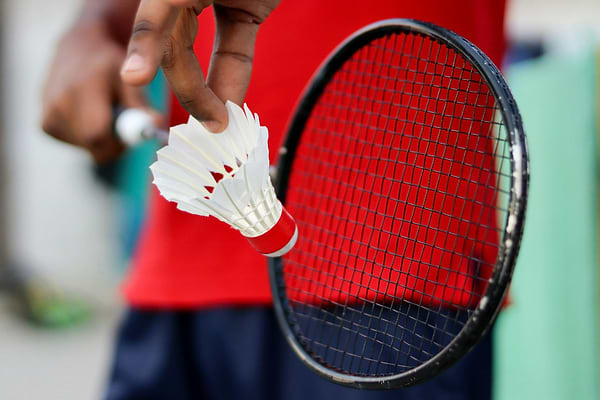
Do you have to serve below the waist in badminton?
At club and domestic level, yes. The long-standing rule is that the whole shuttle must be below the server's waist at the moment you strike it, and the waist is defined as an imaginary line around the body level with the lowest part of your bottom rib. On top of that, the shaft and the head of your racket must be pointing downwards at contact. Put simply, you cannot flick the shuttle up and hit it flat with a whippy, tennis-style action.
There is a second version you will see on television. In 2018 the Badminton World Federation replaced the waist rule at international events with a fixed height: the whole shuttle must be below 1.15 metres from the court surface at contact. It was brought in to make service judging consistent, because "the lowest rib" sits differently on every body and is impossible to police fairly. That 1.15 metre law is now standard on the world tour, but most club leagues still use the older below-the-waist wording, so that is the one to learn first.
Either way, the spirit is the same: the serve is hit from low down in one smooth forward motion, with both feet stationary and touching the floor (and off the lines). No shuffling or hopping to put someone off. It is meant to be an honest start to the rally.
Can you serve overhand in badminton?
No. This is the single most common misunderstanding for people coming from tennis or squash. There is no overhead serve, no second serve, and no let for a poor toss. Because contact has to happen below the waist (or below 1.15 metres) with the racket pointing down, every legal badminton serve is effectively an underarm serve. You can hit it forehand or backhand, but the shuttle always leaves your racket travelling upwards from a low point.
That constraint is what makes serving interesting: forced to hit up, the whole game becomes about how little you give your opponent to attack.
Where do you serve from in badminton?
You always serve diagonally, from your service court into the one opposite. Which side you stand on is decided by your score: serve from the right-hand court when your score is even (including 0), and from the left-hand court when it is odd. Glance at the score before serving and you will never stand in the wrong box.
The court lines change between formats too. In singles the service court is long and narrow: the back tramline is in play, the side tramline is not. In doubles it is the opposite, short and wide, so the side tramlines count but the very back tramline does not, which is why a doubles serve that drifts long is out. Knowing this stops you chasing serves you should let land.
The low serve, the flick and the drive
Once legal, the serve becomes a tactical shot. Three deliveries cover almost everything at club level.
- The low serve. The bread and butter, especially in doubles. You are aiming to skim the shuttle just over the net so it starts falling the instant it crosses, giving the receiver nothing to hit down on. A tight low serve is worth more than any fancy alternative.
- The flick serve. A disguised serve that starts like a low serve but sends the shuttle quickly over the receiver's racket to the back of the court. Its whole value is surprise, so it only works if it looks identical to your low serve until the last moment.
- The high serve. Mostly a singles shot. You lift the shuttle high and deep so it drops almost vertically into the back tramline, pushing your opponent back and buying yourself time to get set.
None of these is about power. Serving is a touch skill that rewards consistency far more than force, and practising fifty low serves at a floor target will do more for your game than almost any other solo drill.
How to serve in badminton doubles
Doubles serving flips the priorities. In singles you have space to cover, so a deep high serve is fine; in doubles the receiver is ready to pounce, so the low serve is king and almost everything is served short. Most players now use a backhand serve, held out in front of the body, because it is compact, quick, and easy to keep low and consistent.
Only one player serves per side (there is no "second server" in the modern rules), and the pair usually stands front-and-back, ready to attack the reply. If you play a lot of doubles, grooving a tight, repeatable backhand low serve is one of the highest-value things you can practise.
A quick word on scoring
Under the rally-point system used since 2006, a point is scored on every rally regardless of who served, so you no longer have to be serving to win one. Games are first to 21, you must win by two, and if it reaches 29-29 the next point takes it at 30. Because every rally counts, a weak serve is not a "free" mistake any more: give away three loose serves and you have handed over three points you never had to lose.
Common faults, and how to stop giving points away
Most service faults at club level come down to a few habits: contact creeping above the waist, the racket head pointing sideways instead of down, a foot shuffle before contact, or standing on a line. The cure is almost always to slow down: set your feet, get still, check the score for the right box, and make one smooth forward swing. If in doubt, serve a fraction lower and tighter than feels natural.
It helps to take the equipment out of the equation too. A worn or inconsistent shuttle will flutter off a delicate low serve, so it is worth using a good shuttle for your level. Serving touch also lives in the racket, so a racket that suits your game and sensible string tension make that soft, controlled contact easier to repeat.
None of this is complicated once you strip it back. Serve low, serve legal, serve to a target, and pick the right delivery for the format. Do that and the serve stops being the shot you dread and becomes the small, quiet edge it was always meant to be.


