
How to Smash in Badminton: The Shot That Wins Points
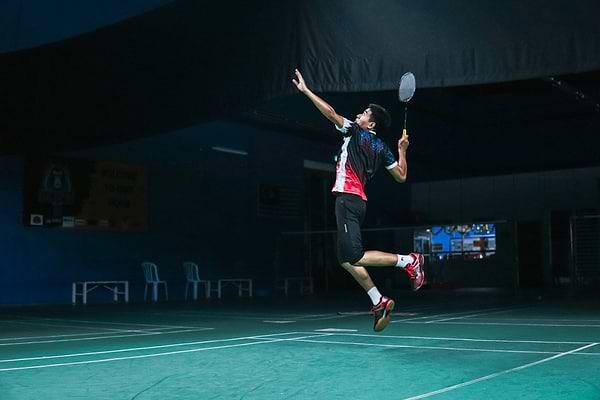
Ask a room of club players which shot they most want to nail, and the answer is almost always the same. The smash. It is badminton's finishing move, the moment the shuttle turns from a soft, drifting thing into a blur pointed at the floor. Watch Viktor Axelsen crush one from the back court, or Loh Kean Yew turn a routine lift into an ending, and you can feel why: a good smash does not just win a rally, it settles the argument.
The good news is that a proper smash is not really about brute strength. It is about sequence, timing and the small habits your opponent never sees. Get the sequence right and even a modest club player can hit a smash that finishes rallies. Here is how to smash in badminton, how to choose the right moment for one, and how to make yours a little sharper each week.
What actually makes a badminton smash
A badminton smash is any overhead shot hit down into the opponent's court at a steep angle, with pace. That is it. Elite players can push the shuttle past 400 kph off the racket, but speed is a symptom, not the goal. The goal is a steep, awkward angle that the opposition cannot lift back comfortably. A gentle-looking half smash that hits the deck just inside the tramline is often more damaging than a top-speed effort straight at the receiver's racket.
So think of the smash as a shape rather than a power move. You are trying to get above the shuttle, in front of it, and drive it down. The pace follows from the shape.
The technique, step by step
Break the smash into four moments and it becomes far easier to drill.
1. Preparation and stance
Turn side on to the net with your non-racket shoulder pointing forwards, weight loaded onto your back foot. Racket arm bent, elbow up around shoulder height, non-racket arm raised for balance and to spot the shuttle. You want your body cocked like a spring, not squared up flat.
2. The jump and rotation
You do not have to jump to smash, and beginners are better off not jumping at first. What you must do is rotate. Drive up through your back leg, kick that leg back in the air (a scissor kick if you are jumping), and rotate your hips and shoulders together. Most of the power in a smash comes from this trunk rotation, not from the arm. Players who arm-only their smashes hit slow ones and injure their shoulders.
3. Contact
Meet the shuttle as high and as far in front of your body as you can. Contact point is everything. The higher and more forward the contact, the steeper your smash can go. Your racket face should be angled slightly down, not vertical. The wrist and fingers do the last snap: grip loose during the swing, then squeeze at impact for that satisfying, pinging sound off the strings.
4. Follow through and recovery
Let the racket travel through and finish on the non-racket side of your body. Land softly, ideally on your racket-side foot, and take a quick recovery step back towards the middle of your court. A smash without a recovery step is a gift, because the reply is almost always a fast block into the space you just vacated.
Grip, racket and strings: the boring stuff that matters
Use a basic forehand grip, almost the same as shaking hands with the handle. Keep it relaxed. Squeezing the grip through the whole swing kills racket-head speed, which is where smash pace really comes from. If the handle is slippery or worn, that alone can cost you kilometres per hour on the shuttle; a fresh overgrip is one of the cheapest upgrades in the sport, and you can browse a range of grips to find one that suits your feel.
Racket choice matters too. Attacking rackets tend to be head heavy with a stiff shaft, which loads more mass behind the shuttle at impact. That is why Yonex's Yonex Astrox range is so popular with smashers. If you are unsure whether your current racket is helping or hindering your attack, our buying guide to badminton rackets walks through balance and stiffness in plain language.
Strings and tension are the third piece. Higher tensions give a crisper, more precise feel and reward good technique, while lower tensions offer more repulsion and forgiveness. If your smashes feel like they die in mid-air, worn strings or a tension that no longer suits you may be the culprit. Our string and tension guide covers what to try.
When to smash, and when not to
A good smash chosen at the wrong moment is still a bad shot. The best players smash surprisingly less often than club players do, because they know it is a shot that trades attack for balance.
Smash when you have got in front of the shuttle, are inside the back third of the court, and can hit down at a steep angle. Look for lifts that fall short, lifts that drift towards your forehand, and any moment your opponent is off balance or out of position.
Do not smash from behind the baseline unless the angle is genuinely there. From the very back of the court, the shuttle has to travel a long way, giving the receiver time to set. A steep, three-quarter-pace smash from mid court often finishes a rally that a full-power effort from the back would not.
Singles and doubles: two different smashes
In singles the smash is a scoring shot, but it is also a tool to force a weak reply. Aim between the receiver and their backhand side, or straight at their body, to jam them up. Follow the smash in aggressively; a short block on the return is a common winner.
In doubles the smash is the engine of the whole attacking rotation. The rear-court player smashes hard and steep, the front-court partner picks off the block or drive. Angles matter more than raw pace here. A flat, powerful smash straight at a good defender will come back at you. A steep smash into the tramline, or into the seam between two players, opens the front court for your partner.
Four drills to sharpen your smash
You do not need a coach to improve. Try these on any club night.
- Shadow smashes. No shuttle, no partner. Ten reps of the full sequence: turn, load, jump, rotate, land, recover. Two sets. It bakes the shape in.
- Multi-feed smashes. A partner hand feeds lifts to your rear court, you smash straight, cross, then a half smash to a target. Focus on contact point and recovery step, not pace.
- Smash and block. You smash, partner blocks, you race in to net and play a tight net shot. Great for the second-shot habit that so many club smashers miss.
- Steep-only smashes. Set a chair or cone halfway up the opponent's court. Only count smashes that land in front of it. Forces you to hit down, not flat.
Look after your body
The smash asks a lot of the shoulder and the achilles. Warm up properly, stretch the shoulder before you unload big ones, and land soft. Shoes that no longer grip or cushion are a common cause of injury and a common thief of jump height; if yours are past it, our buying guide to badminton shoes is a sensible next stop.
Small changes, big pay off
Most club players' smashes are not held back by strength. They are held back by contact point, by squeezing the grip, and by not recovering after the shot. Fix those three things and you will feel a difference within a session. Add a racket and grip that suit your game and you will hear it too, in that clean, sharp thwack that tells the receiver the rally is already over.


