
Spotting a Fake: How to Tell a Genuine Yonex Racket from a Counterfeit
Yonex is the most recognised name in badminton. It is the racket in the hands of most of the world's top players, the brand club players aspire to, and that popularity has an unwelcome side effect: it is also the most faked. Search any online marketplace or scroll a social media feed for long enough and you will find Astrox and Nanoflare models at prices that look too good to be true. Usually, that is exactly what they are. If you are spending your hard-earned money on a serious racket, it pays to know how to spot a fake Yonex before it reaches your bag.
This is not about scaring anyone off buying online. It is about buying with your eyes open. Below we look at why counterfeits have become so common, how a fake lets you down once you actually play with it, the practical checks that help you tell real from replica, and why buying from the brand or an official stockist is the one step that removes the guesswork. When you are ready for the real thing, our range of genuine rackets from brands we trust is a safer starting point than a bargain from an unknown seller.
Why are there so many fake Yonex rackets?
The simple answer is demand. A top-end Yonex racket is a premium product with a premium price, and wherever there is a desirable, costly item, counterfeiters follow. The maths is appealing to them: copy the paintwork of a model everyone wants, sell it for a fraction of the real price, and plenty of bargain-hunters will take the risk. Online marketplaces and social media ads have made it easier than ever to reach those buyers directly, far from any shop counter where a knowledgeable person might raise an eyebrow.
The fakes have also become more convincing. Where once a counterfeit was obvious from across the room, many now copy the cosmetics closely enough to pass a quick glance in a photograph. That is the trap. The cost has been cut somewhere, and with a racket the savings come out of the materials and the build, which is precisely the part you cannot see in a listing. For help choosing the genuine model that actually suits you, rather than chasing a logo, our rackets buying guide is a good place to start.
Are fake Yonex rackets any good?
In a word, no. A real Yonex racket is the product of serious engineering: specific grades of graphite, a carefully tuned balance point, a stiffness matched to how the frame is meant to be played. A counterfeit copies the look and skips the science. The result is a racket that feels dead and soft rather than crisp, that may be noticeably heavier or oddly balanced, and that loses the repulsion and control you were paying for in the first place.
There are safety and value problems too. Cheaper materials and weaker joints mean fakes are far more likely to crack or snap under a hard smash, sometimes alarmingly so, and the grommets often split early. They tend to arrive strung with cheap string at a random tension, if they are strung well at all, so the racket never plays as intended. A genuine frame can be strung to a tension that suits your game, and it carries a real warranty. A counterfeit carries neither. Put bluntly, a fake is not a cheap version of a good racket, it is a different and far worse product wearing the same paint.
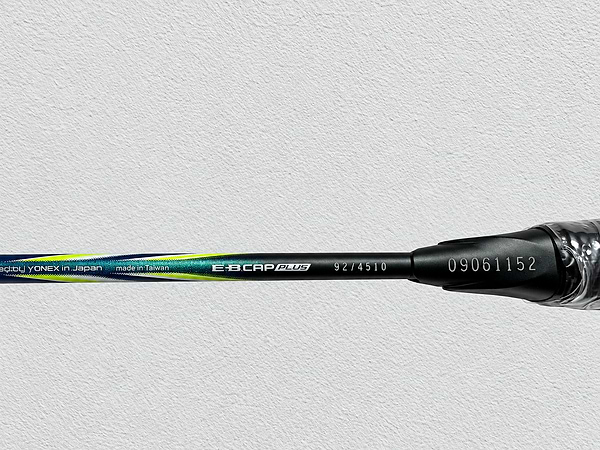
Yonex Astrox 100 Tour VA made in Tawain, photo taken from our own stock at Badminton HQ
How to check a Yonex racket is genuine
No single test is foolproof, but genuine Yonex rackets share a set of details that fakes routinely get wrong. Run through the following and look for anything that does not add up.
- The price and the seller. This is the biggest tell of all. A current flagship model at half the usual price, from an unfamiliar marketplace seller with no badminton pedigree, is a warning sign before you have even seen the racket.
- The production code on the cone. Genuine rackets carry a laser-engraved code on the cone (the cone is the trumpet-shaped joint where the shaft meets the handle), including a manufacturing date and a country code. On many fakes this code is simply printed on, so look closely at whether it is engraved into the surface or sitting on top of it.
- The hologram and serial number. Look for a clean, crisp hologram sticker and a neatly printed serial number on the shaft. Smudged printing, wonky fonts or a misspelt logo anywhere on the frame are immediate red flags.
- Under the grip. If you can, lift the original grip and check the wooden handle for a barcode sticker. Genuine rackets have one; a bare handle is suspicious. A fresh overgrip goes straight back on afterwards.
-
Build quality and feel. Inspect the paint, the logos and the grommets for sloppy finishing, and sight down the shaft to check it is perfectly straight. Genuine frames feel stiff and rigid when you twist them gently; many fakes feel noticeably soft.
One more point worth knowing, because it comes up a lot: genuine Yonex rackets are not all made in Japan. The brand manufactures in several countries, and the country code on the cone reflects that. A "made in Taiwan" or "made in China" racket is not automatically a fake, so do not treat the country alone as proof either way. Judge the racket on the whole picture, and on where you bought it.
The surest check: buy from the brand or an official supplier
All of the above helps once a racket is in your hands, but there is one step that removes the risk almost entirely, and it happens before you buy. Purchase from the brand directly or from an official, authorised retailer, and the question of genuine versus fake simply does not arise.
That is exactly how we operate at Badminton HQ. We buy our rackets only from the brands themselves or their official UK distributors, never from grey-market importers or third-party marketplace sellers. Every Yonex racket we sell comes through that official supply chain, which means it is the genuine article, built to specification, and backed by the proper manufacturer warranty. When you are choosing a racket you can have it strung with a quality string to your preferred tension, and you can play your first game knowing the frame is everything it claims to be.
A bargain that turns out to be a counterfeit is no bargain at all. It plays worse, it lasts less time, it carries no warranty, and at worst it breaks mid-rally. Learning the checks above is well worth doing, but the real peace of mind comes from buying genuine in the first place, from a source you can trust.


