
The Quiet Engine of Badminton: Why Footwork Wins Rallies
Watch any highlight reel and it is always the smash that makes the crowd gasp: the leap, the crack of the strings, the shuttle fired into the floor. Yet ask a coach what really separates a club player from a county player and they rarely mention the smash. They talk about the feet. Badminton footwork is the quiet engine of the whole game, the thing that gets you to the shuttle early, in balance, and ready to do something clever with it. Learn to move well and every other part of your game quietly improves.
What is footwork in badminton?
Footwork is simply the set of movement patterns that carry you around the court efficiently and back to a central position, ready for the next shot. It is not the same as running. A player who sprints flat out to every corner arrives late, off balance, and out of ideas. Good footwork is a small repertoire of specific steps, such as the split step, the chassé, the lunge and the recovery step, strung together so that you glide rather than scramble.
The other half of footwork is what happens after you hit. Every good movement ends with a push back towards your base, the central spot from which you can cover the whole court. Reaching the shuttle is only worth anything if you can get back in time for the reply.
Why is footwork so important?
Three reasons, really. First, movement buys you time. Arrive at the shuttle early and you suddenly have choices: you can clear, drop or smash from the same balanced position, and your opponent cannot read which. Arrive late and you are just trying to survive.
Second, balance creates power and control. A clean, powerful shot comes from a stable base and a smooth transfer of weight, not from swinging harder. If your feet are in the wrong place, even a lovely arm action produces a weak reply.
Third, efficient movement saves energy. A match can run to three long games, and the player who wastes less energy getting around the court is the one still hitting cleanly at the death. It is no accident that the players remembered for their movement, from Lee Chong Wei's blistering speed to Lin Dan's uncanny balance and Viktor Axelsen's economical court coverage, tended to look calm long after their opponents were blowing hard.
Start from the ground up
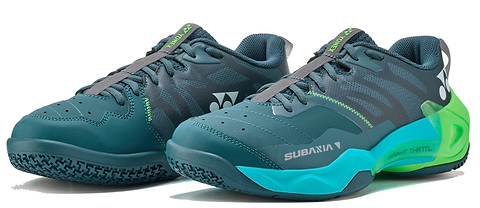
Before any drill, footwork begins with what is under your feet. Badminton is played on a fast indoor surface with constant stops, starts and lunges, and that puts real demand on your shoes. A proper pair of indoor badminton shoes gives you a non-marking gum sole for grip, a low profile that keeps you close to the floor, and cushioning built to absorb the shock of repeated lunging. Running trainers, by contrast, sit you up high on a soft heel built for moving forwards, exactly the wrong shape for the sideways braking a badminton court asks of you, and on a polished sports hall floor a genuine ankle risk.
If you are not sure what to look for in terms of fit, weight and support, our badminton shoes buying guide walks through it. Get the footwear right and the rest of your footwork has something to build on.
The building blocks of good movement
The split step
The split step is the single most useful thing most club players are missing. Just as your opponent is about to hit, you make a small, light hop that lands you on the balls of both feet, knees soft. It sounds trivial, but that tiny bounce primes your legs like a loaded spring, so you can push off instantly in whichever direction the shuttle goes. Without it, you are flat-footed and always a fraction late.
The chassé and the lunge
For covering ground to the sides and back, the chassé is your friend: the feet move together in a quick shuffle rather than crossing over, which keeps you balanced and facing the right way. As you reach the shuttle, especially at the net or in the rear corners, the movement finishes in a lunge, with the front knee bent over the front foot and the weight controlled rather than falling forwards. A good lunge lets you hit and then push straight back out of the same position.
Recover to base
After every shot, the habit to build is an immediate push back towards the centre. You will never stand perfectly on the base spot, and you should not try to, but always drifting back towards it means you are rarely caught badly out of position. Think of base as home, and every rally as a series of quick errands out and back.
How can I improve my footwork at home?
The best news about footwork is that you do not need a court, a partner or even a shuttle to work on it. Some of the most effective badminton drills are done alone in a garage, garden or living room.
Shadow footwork, sometimes called ghosting, is the classic. Imagine a shuttle being played to each corner and move to it with proper steps, split step, travel, lunge, then recover to base, before moving to the next corner. Do it slowly and correctly first, because speed built on sloppy technique just makes you faster at moving badly. A six-corner pattern, touching two front corners, two mid-court sides and two rear corners in turn, is a brilliant workout for both movement and fitness.
A skipping rope is another quiet hero. Five minutes of skipping builds the light, springy ankles that make the split step work and the calf strength that lunging demands. Little and often beats one heroic session: even ten focused minutes, two or three times a week, will show up on court within a month.
Common footwork mistakes to avoid
A few habits hold most players back. Standing flat on your heels waiting for the serve, so you are slow off the mark. Watching your own feet instead of the shuttle and your opponent. Crossing your legs on the move, which leaves you tangled and unbalanced. And, most common of all, admiring your shot and forgetting to recover, so you are stranded when the reply comes back. None of these are hard to fix once you know to look for them.
The skill anyone can own
What is lovely about footwork is how democratic it is. Not everyone can generate a 400 kilometre per hour smash, but everyone can learn to move a little earlier, land a little more balanced, and recover a little quicker. It rewards practice rather than raw athleticism, and it keeps paying off for as long as you play. So next time you watch the very best, try ignoring the racket for a rally or two and watch the feet instead. The magic was there all along, just lower down than we tend to look.


