
Your Racket Isn't the Spec Sheet: How Strings, Grips and Wear Change the Real Numbers
Pick up almost any badminton racket and it will introduce itself with a tidy set of numbers: a weight code, a balance point, a flex rating, a grip size. We choose rackets by these figures, argue about them online and pay a premium for the ones that promise the right blend of power and control. Here is the awkward truth, though. The racket described on that spec sheet does not really exist once it reaches your hand. The moment it is strung, gripped and played with, the numbers start to drift, and some of them move a surprising distance from where they began.
This is not a flaw. It is simply what happens when a bare frame becomes a finished, personalised playing tool. Understanding how and why it drifts helps you choose better in the first place and customise with your eyes open. To follow along it helps to know what weight, balance and flex on the spec sheet actually mean, so we will start there and then watch each one change.
What the numbers actually mean
Weight is usually given as a Yonex-style U code, and it describes the bare, unstrung frame. Lower numbers are heavier: 3U sits at roughly 85 to 89 grams, 4U at about 80 to 84 grams, and 5U at around 75 to 79 grams. Balance is the point where the racket would sit level on a fingertip, measured in millimetres from the butt of the handle. Push that point towards the head and the racket plays head heavy, which adds hitting mass and power. Pull it back towards the handle and it plays head light, which feels faster and more manoeuvrable. Flex describes how much the shaft bends and springs back, from stiff to flexible. Grip size, finally, is a code for the handle circumference. Every one of these is measured on the frame before you have added a single thing to it.
Stringing changes the racket before you even hit a shuttle
A full restring uses only around ten metres of very thin string, so the added weight is tiny, often little more than a gram or two. That small mass sits up in the head, so it nudges the balance a fraction that way, but the real story of stringing is not weight at all. It is tension, and tension quietly rewrites how the whole racket performs. It is well worth reading a proper string tension guide before you commit to a number, because the difference between a low and a high setting is enormous in the hand.
How tension changes performance
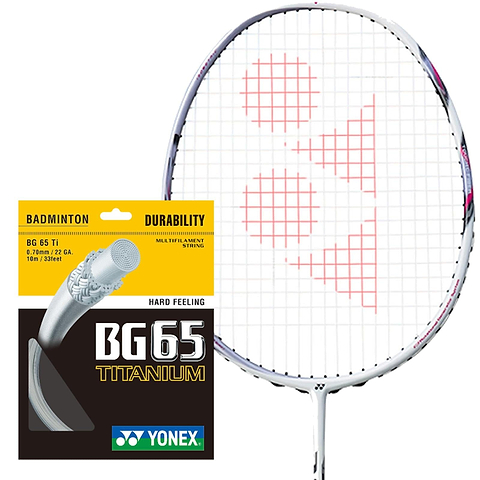
String at a lower tension, say the low twenties in pounds, and the string bed behaves like a trampoline. It flexes more on contact, returns more energy to the shuttle and gives you easy power and a big, forgiving sweet spot. String tighter, up into the high twenties or beyond, and the bed becomes a stiffer, flatter surface. You lose some of that free power but gain control and a cleaner, crisper response, at the cost of a smaller sweet spot that punishes anything hit off centre. Two identical frames, strung ten pounds apart, feel like different rackets. String type and gauge play their part too, which is why a durable all-rounder such as the Yonex BG 65 Ti feels quite unlike a thin, high-repulsion power string, even at the same tension. It is worth browsing the full range of badminton strings with that in mind.
There is a second, sneakier change. A string bed starts losing tension the instant it comes off the machine. It drops a few pounds in the first days and keeps sliding gently after that, so the racket you loved when it was fresh is softening a little every week. Much of what players describe as their racket "going dead" is simply this steady tension loss, not the frame at all.
Grips: the biggest hidden change to your balance
If stringing barely touches the weight, gripping most certainly does, and this is where a racket can move furthest from its printed balance. Everything you wrap onto the handle adds mass at the very end of the racket, which drags the balance point back towards head light and takes a little sting out of the swing. A thin overgrip is modest, adding only a few grams, but it still shifts things. A chunky replacement grip, and especially an absorbent towel grip, can add many times that, and the effect stacks up fast.
So does a genuinely head-heavy racket become head light when you add an overgrip? Not entirely, but it certainly moves in that direction. One light overgrip will nudge the balance a few millimetres towards the handle and shave a touch off the swing weight. Stack two or three, or reach for a towel grip, and a racket sold as an attacking, head-heavy weapon can start to feel noticeably more neutral and whippy. Some players use exactly this trick on purpose, buying a head-heavy frame and then taming it with grip until the balance suits their arm. Others keep the original grip and add the thinnest overgrip they can, precisely to preserve the head-heavy feel they paid for.
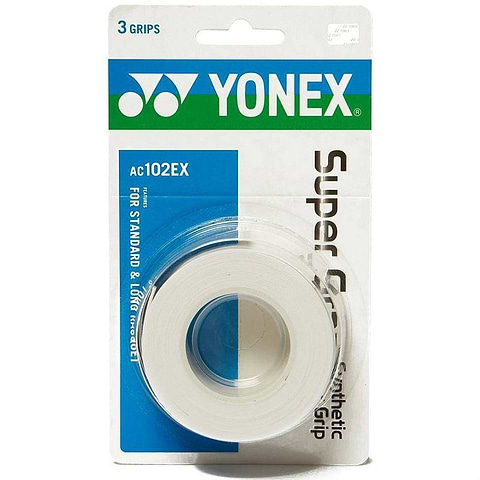
Grip size drifts too. Every layer you wrap increases the handle circumference, so a racket bought in one grip size gradually becomes a size or more larger as overgrips build up. That changes how securely you can hold it and how freely your fingers can work the racket at the net. If you are unsure what suits you, the grips buying guide is a good place to start, and the grips and overgrips range covers everything from tacky replacement grips to a simple three-pack like the Yonex AC102EX Super Grap.
Does the graphite itself go soft?
This is the question that gets debated most, and the honest answer is more nuanced than the myths. Modern frames are carbon fibre held in a resin, and that material does not compress or sag like a piece of foam. A racket will not quietly lose half its stiffness just from ordinary rallies. What can happen, over a lot of use, is fatigue in the resin at a microscopic level, and that is a slow process rather than something you feel from one month to the next. The dramatic loss of stiffness people sometimes report almost always has a different cause: a hairline crack from a frame clash or a mis-hit on the rim, which is damage rather than natural ageing, and a sign the frame is on its way out.
In other words, if your once-crisp racket now feels dull and soft, look at the string bed and the grommets before you blame the graphite. Nine times out of ten it is tension loss and a tired set of strings doing the talking, and a fresh restring brings the racket most of the way back to how you remember it.
What actually drifts over time, and what to do about it
Put it all together and a clear picture emerges. Your racket's real specifications are a moving target. Tension falls from day one, so feel softens steadily until you restring. Grips add handle weight and pull the balance towards head light, and they build up the handle size as you add layers. Grommets and the string bed wear, changing response long before the frame is anywhere near finished. The frame's flex, by contrast, is the most stable number of the lot, right up until the day it is damaged.
The practical takeaways are simple. Restring on a sensible schedule rather than waiting for the strings to snap, because you are chasing feel, not just avoiding breakage. Choose your customisation deliberately: if you love a head-heavy swing, keep the grip light, and if a frame feels a shade too head heavy in the shop, remember that your grip of choice will calm it down. And when you are picking your next frame, read the numbers as a starting point rather than gospel, knowing you will shape the finished racket yourself. Browse the racket range with that mindset and you will choose far more confidently, because you will understand not just the racket on the shelf, but the one it will become in your hand.


